© Ivan Krašnja private archive
The Women's sector of the Rab Concentration Camp captured in a postcard from 1943. Od the left side a small part of the Jewish sector (built barracks) is visible.  


A white-haired, svelte-figured man, who introduced himself as Ivan Krašnja (1947), approached me at the opening of the Last Witnesses, memories from fascist camps exhibition in Maribor. In his hand a black and white photo. It turned out to be a postcard from Rab, dated September 13th 1953. He was holding a postcard capturing a fascist concentration camp for civilians on a Croatian island of Rab, operating from July 1942 to September 1943. The concentration camp is represented in it's late phase of operation when the tents were removed and inhuman living conditions improved. 
His father Janez Krašnja (1911-1967) wrote a postcard as a former fascist camp internee sending regards to the family while participating at the 10th anniversary of the camp liberation. 
Janez was working as a teacher in Maribor and just got his firstborn child, daughter Jelka (1941), when the war in Yugoslavia broke out. In April 1941, Maribor was occupied by the Nazis. Janez decided to move his family to fascist-controlled Ljubljana, which was believed to be a safer place.

In July 1942 he was denounced to the Italian authorities as a member of intelligence and a reserve officer of Yugoslav royal army. He was sent to Rab concentration camp. Early in the year 1943 the Italian army started to mobilize internees for Milizia Volontaria Anti-Communista (MVAC), a fascist controlled anticomunist volunteer militia, which would help them fight the partisans.
Janez, weighing only 40 kilos at the time, was at the very end of his life strength and volunteered to join the militia he personally disagreed with. He considered this step as the only way to save himself and to see his family again.
Though totally exhausted, he managed to jump off a moving train on the way from the camp to Ljubljana. He was hiding in a village close to Ljubljana and got in contact with his wife Marica (1913-1963).  He slowly recovered and looked forward to join the partisan resistance movement.

Only in January 1944 did he manage to get in touch with the partisan movement. Years later he discovered why it took him so long.
In the paranoid war years he was considered untrustworthy for he was released from the fascist camp before the eventual capitulation of the fascist regime in September 1943. The stigma of suspicion had chased him deep into the postwar years.
Apart from its documentary value, the postcard is a medium of a touching war memory, which addresses a fundamental dilemma, familiar to the majority of the people during the war. Any war. Which principle to follow? The one that is in accordance with the idea of national liberation or the one that keeps you and your family safe? Often the two choices exclude one another.


                                                                                           © Manca Juvan

At 99, Anton Vratuša is the oldest living survivor of italian fascist concentration camps in Slovenia. During fascist occupation he was, as an academic and as a member of resistance, arrested in Ljubljana. 
Than he was in internment in four fascist camps.
First he was deported to fascist camps for civilians and political prisoners in Italy: Gonars, Treviso and Chiesanuova (Padua). From there he was transferred to a Croatian island Rab, a camp where the internees from Slovenia suffered the most.

Experiencing four of twelve major fascist concentration camps for inhabitants from occupied slovene ethnic territories of the Kingdom of Yugoslavia we looked forward to Mr. Vratuša for a simple answer about the character of fascist camps. 

 "I can not give an unanimous description of fascist concentration camps," Ms. Vratuša said. 
Each group of internees had a different experience depending upon the time of her internment. Living condition varied depending of the state of development of the detention facility and the geographical region. Some of the camps were in use as detention sites before the outbrake of the second world war, some were under construction and internees were caring out the building works. Internees experienced wildly differing circumstances. According to their testimonials they all suffered malnutrition, poor hygiene and general neglect. 
There was something Mr. Vratuša was able to summarize about Italian fascist concentration camps: "I noticed that the majority of internees suffered badly. They were thinking only about the tragedy they found themselves in. I've made a decision that I will carry on my fight inside the camp or from the outside. I don't remember experiencing tragedy. I was an activist and I behave as such, as an activist."
"Several hundreds students and university colleagues were sent first to a concentration camp Gonars," Mr. Vratuša told. The very second day of the internment Mr. Vratuša, at the time a young intellectual in his activist mode, didn't follow the orders to salut with a fascist Saluto Romano. His act of disobedience created confusion. He was tied at the pillar and left without food and water for a day. "After that they left me alone. I continued my culture work and taught internees as an activists of the national Liberation front. As many others I was fighting the aggressors with different means."

From Gonars he was transfered to three other fascist concentration camps: Treviso and Padua in Italy and the island of Rab in Croatia.

Did concentration camp managers used similar punishment methods?
"Tying to the pillar was a common method.  Sometimes internees were bitten, but not as much as at Rab. There the camp commander, Colonel Vincenzo Cuiuli, was feroce - ferocious. He used to hit internees with a whip and used his dog for intimidation. One of the internees was caught while escaping. Cuiuli in person shot him to death. Compared to other camps leaders he was the most violent. For that reason the concentration camp on Rab became known as an execution camp."
At the time of the Italian capitulation in September 1943 Mr. Vratuša was part of the underground military movement, who's leaders carried on a  take over of the concentration camp Rab. Between 3.500 internees, majority of them of Slovene nationality, 300 Jews and 60 of Croatian nationality formed a Rab Brigade and disarmed the italian army. No casualties were recorded. 


© Manca Juvan

When Magda Lovec Trtnik (1932) attended school in occupied Ljubljana she wasn't allowed to tell her father was shot as a hostage and her mother killed at Urh, a location known for torture and killings of partizans and supporters of the resistance. "Tell them they died before the war," were the instructions Ms. Lovec Trtnik, a World War II orphan, received.

For years she was holding for herself events that marked her life since she was nine years old. For her as for many others the Word War II and the italian occupation of the slovene territory turned into a life sentence.
The truth is that her father, a political activist and member of resistance, was shot by italian soldiers as hostage in Ljubljana at Gramonza jama on June 11, 1942. 
Tone Trtnik, later a national hero, was one of seven hostages killed that day. Shot hostages were buried in two graves. "At the time my aunt visited the graves and lit the candles. One candle died out. She decided that my father is buried in the grave with the lit candle," Ms. Trtnik explained how this simple belief influenced the location of her father's grave. It stayed unquestioned until today. It is of immense importance and consolation to Ms. Lovec Trtnik to have a known place she can visit and pay respects to her father.

Her mother, Justina Trtnik, was an activist and member of resistance too. "One morning when she left for work - she was working at the paper factory Papirnica Vevče - italian soldiers arrested her," Ms. Lovec Trtnik remembered the September 18, 1942 events. Her mother was arrested and sent in internment on the island of Rab. "The soldiers searched for me too. My grandmother sent me on time to known people in a neighboring village," Ms. Lovec Trtnik beleives that day she escaped the internment.
Letters and postcards her mother wrote in interment where messages of encouragement, care and love. Ms. Lovec Trtnik preserved all of them. She read them many times and she shown them to her children and grandchildren. "When I read her letters and postcards I cry," she told.
Letters are full of mother's care for the daughters survival and future. She was allowed to write to her doughtier on Thursday, we learned form Ms. Lovec Trtnik. Through letters Justina Trtnik encouraged her doughter to learn at school, get healthy and never turn down anything important. In a child story stile she described the internment. She wrote about animals in internment. She wrote about lice.
In April 1943 her mother was released from italian fascist internment. 
Once back home Ms. Lovec Trtnik remembers her mother being weak. But nothing was in a way for Justina trtnik to go back to work. "It's from work that she once came home and announced the capitulation of Italy," Mr. Lovec Trtnik remembered.

The capitulation of Italy was just a short period that turned to be a period of exchange of occupiers, soldiers and troops in Ljubljana and its suburbs. Soon German soldiers took over the territory. With Germans their local allies the so called White Guard and Slovene Home Guard - domobranci got power. They arrested Justina Trtnik at the end of November 1943, seven month after her release from the internment. "She never came back," Ms. Lovec Trnik said. Her mother is one of non-identified victims at Urh.
Ms. Lovec Trtnik assisted to the exhumations of the mass grave at Urh. She was a 13-years old war orphan and she was standing and staring at corpses in an attempt to recognize her mother's outfit. 
The exhumations stopped before all the victims were unburied. Justina Trtnik was never found and she doesn't have a grave. "It is difficult to explain the importance of a memorial place where you can visit your dear ones," Ms. Lovec Trtnik told.

She shown us all the material heritage she is preserving from her childhood: letters, few photos, articles cut from newspapers … Among them was a little orange notebook. She opened it on a page where she wrote dates of her father's birth, arrest and death and of her mother's arrest. It was heart braking to step in shoes of a ten or thirteen years old girl who is writing down in her notebook dates of loss of her parents and not dates of falling in love with a boy from the same class.


          © Manca Juvan
Ivanka Zamida, a survivor of three italian fascist camps, greeted us at her home in Kočevje - the largest city in the area that was exposed to extreme fascist ethnic cleansing and designated, as a region reach in timber, to be populated by Italians from South of Italy. Ms. Zamida welcomed me even if her health was deteriorating. She was open to tell what she remembers. Deeper in the memories we went more upset and agitated she got. Nonetheless she didn't stop. She was committed to make herself available until all what she find important was told.

She was born in a poor peasant family of six children in 1929 in the village of Papeži. Her account began with an incursion of Italian soldiers. "It was an ordinary day. They came and surrounded the village. Soldiers were robing the houses. They took everything. There was not much. They took the chickens, put the pigs on a truck. They killed what they couldn't take. Our heifer didn't want to move. They shoot it and drag it down. They tied the men and locked them in the school building."

The next vivid memory Ms. Zamida recalled located us in Western Croatia, in horse stables in a coastal town of Bakar. At the time she didn't know she arrived in a concentration camp for civilians, first of the three she was in internment. 
Ms. Zamida didn't know her internment didn't start on Rab but in Bakar. How could she? During the time of war she knew her home was burned down, the live stock taken away or killed and that they were forced to leave the village. The internment in the concentration camp was unprecedented to her and to the memory of her family. She was familiar with the war and the loss of soldiers. Many men from her area were enrolled and fought the WW1. The concept of internment of civilians was new.

Later, during the post WW2 period in Yugoslavia she could't gain much insight in her internment - fascist concentration camps were not a topic of significant importance. Similar was at the level of european historic research of WW2 and social awareness.
Until today Bakar concentration camp for civilians remains poorly researched. The area of the camp and it's cemetery are part of an industrial area. 
The Italian army established the concentration camp for civilians in Bakar soon after occupation of half of Croatia's territory in June 1942. Visiting the area with a colleague, an audio documentarist Andrea Giuseppini, a writer, journalist and translator Giacomo Scotti, known as a fervent anti-fascist and communist, and a kind local men, Ivan Butković, who guided us to the camp location, we were looking for a memorial. Nidless to say, we found a vast industrial area and looked at the supposed cemetery of camp victims over a high metal fence. 

Ms. Zamida remembered her mother being in an awful condition in Bakar. "The doctor said, she would receive help if not an interee," Ms. Zamida recalled. Shortly a whole family, except two sons who where migration workers in France, was transported to the concentration camp on island of Rab: women in a female section, their father in the male section of the concentration camp. Her mother, Julijana Zbašnik, died soon after arrival on Rab. 

"Father was visiting us during our stay on Rab. Three sister and me were so foolish to put bread aside for him. If he didn't come to collect it, we sent it through our cousin. He never delivered the bread to our father. He ate it himself."

In the concentration camp Kampor on the island of Rab children until age of 14 were forced to the sea. "I was so sad. I couldn't socialize. I sat on my mess bowl touching the sea with my feet. I couldn't do much. I was so sad." And they were suffering hunger.

As children they searched kitchen rotting leftovers hoping to find something to calm the persistent hunger. "Out of desperation I was once among this kids. Suddenly an officer hit me on the head with a stick having a metal square and a hook on the top. I was wounded. I've got a bruise and a swelling on my head."

There were other reasons than officer's violence that prevented her from searching food scraps: "Didn't take us long to learn that kids eating rotting food were soon gone." 
Remembering a short documentary made on concentration camp of Rab Ms. Zamida got upset. "My son Dušan brought me the documentary. I can not watch it," she made it know that remembering requires a substantial amount of control to cope with strong emotions that could overwhelm her at any moment. At that moment I was questioning myself if awakening survivor's past memories of dehumanization, suffering, pain, mistreatment, violence, loss, death and illness is appropriate. As a researcher and an interviewer I needed to stay with my grief. The gift of empathy at moments seemed to be a curse.

"My uncle died there, my aunt, … I lost at least ten relatives on Rab and at home, where they were killed," Ms. Zamida summarized her family loss in war.

She was moved from Rab to a concentration camp in an italian town of Gonars, to a barrack number 21. She remembers arriving during a cold snowy winter.

Among many memories she recalled a priest who was holding a mass. "I didn't attend. I stop attending mass since I saw the priest blessing the dead and the alive who were than shot. I don't judge the existence or the non-existence of god. If there is God, he would act at the time when we were suffering so much," Ms. Zamida placed herself among many who, while exposed to atrocities, looked forward for an action of an interventionist God. As for many, so for Ms. Zamida, God died during WW2. 
To whom could possibly turn a 14 years old girl who is kept captured in an unknown land, suffering extreme deprivation and fighting flies, malnutrition and dysentery.

In September 1943 she and her sisters left the concentration camp at Gonars among the first. They were disoriented and walked the Italian territory left to the mercy of its inhabitants. "One of the woman told us to left behind our handicapped sister. Can you believe this? " She recalled they walked from Gonars to Udine and back to Palmanova where they caught a train to Slovenia. The train was taking them for an approximately hundred kilometers ride back home to the occupied territory where Slovene Partisans, an anti-nazi resistance movement, were fighting Nazi Germans.

Her cousins didn't left with first groups of internees. They were captured by Nazi Germans and transported to the Dachau concentration camp. "They died in Dachau. If they would left with us, they would be alive," she remarked. 
Ms. Zamida and her three sisters reached their village to find out that nothing was left behind. Begging for food marked their recovery from internment until they find a job as maids. Her father returned from the internment too.

Our interview was over and Ms. Zamida's son Dušan joined us. He was tensed and overwhelmed by the event too. While talking in the living room there was more light and less heaviness. Looking at Ms. Zamida I noticed her face mussels relaxed. Her right hand stopped shaking.


                                                                                                © Manca Juvan

As a preteen, Albina Vogrin was deported to a fascist concentration camp with her family. They first stayed in a tent on the island of Rab, and later they were transferred to barracks in Gonars. Their transfer to the concentration camp in Gonars and the subsequent move into barracks at first provided a source of happiness for them in those desperate times of cold gripping terror, weakness and starvation.

I arrived to find a lively and spirited 83-year old woman who was patiently awaiting my first question to help awaken those distant memories for our face-to-face interview.
Historically her words are all that is left from her internment - an internment as lived by a 12-year old girl. There are no photographs, no personal items, no institutionalized collective memory of the Italian fascist concentration camps.
We began with her forced separation from her roots.

Like other families in occupied Slovenia, Albina's eight member family was violently forced out of their home. They ran into the nearby hills, taking almost nothing of their possessions. What they saw when glancing back was a fiercely burning fire where their house and their village once stood. "Seeing our house in flames hit me badly."
Only after the war was over, when Ms. Vogrin was invited to a bonfire, did she realize how deeply she had been wounded: "Seeing the fire I collapsed and ran away. After witnessing our home on fire, I wasn't able to stand the sight of fire for decades." 
Ms. Vogrin’s flow of memories brought her back to August 1942, when, for a short period of time, Italian soldiers had captured the whole family. They fetched the villagers and gathered all the men in a line, among them was her father. That was the last time the 12-year old homeless girl saw him. "There was a man pointing at three of villagers. He didn't speak Italian. He just said: "Partizans. Beng. Beng." Only after the war did she discover that her father was buried in a mass grave that he and the other hostages had to dig before being shot.

As I was listening to the witness's subjective testimony, I became aware that her word was the sole source of the interview's authenticity. And I felt that was appropriate at the first stage of oral history, which attempts to preserve memories that are at risk of loss. What follows is a very careful crafting of those memories, sensitively extrapolating the fragments of Ms. Vogrin internment experiences.


Memories of internment on Rab


Upon arrival at Rab concentration camp, Ms. Vogrin's family was housed in a weathered tent. She shared the stretched canvas shelter, made to accommodate maximum of four people, with eight others of her family: her eighty year old grandmother, her mother, two sisters, two brothers, her aunt and a cousin. Their tent was just one among hundreds of tents located within the concentration camp whose borders were marked with multiple rows of barbed wire. From the watchtowers, hostile armed guards maintained a vigilant watch. "We arrived on August ninth. It was hot. They didn't give us water. We got a little food. We could all fit into our tent only if we were lying down, one next to the other. It was horrible! And we were always hungry. I know that at that time I was always very, very hungry."

Immediately upon their arrival lice with their piercing mouthparts infested their bodies and feed on their skin. Her mother couldn't hide Albina when the military introduced haircutting as a measure to reduce the parasitic insects. She lost her long braid while the lice stayed. "They gave me the cut braid back. I didn't need it. I was terribly hurt. I was bold. It was hot … I was thirsty … hungry," Ms. Vogrin was re-experiencing her internment.

Occasionally the Italian military provided a reservoir of water, she told. "People crowded around. They were fighting, instead of each person waiting to get some water. Half of the water was spilled." Death soon flooded Ms. Vogrin's memories. It wasn't long after their arrival that people began dying. 
She discovered that death at a concentration camp arrives unnoticed. 
"I heard women's lament and looked into the tent close to ours. Three boys were lying in the tent, covered in lice. Their mother had died earlier and no one gave them food or checked up on them. Couldn’t anyone have taken a look into their tent?" Ms. Vogrin asked rhetorically.

"Many family members died only because they fought over food. They were screaming: 'You've got more. No, you've got more'," is what Ms. Vogrin recalled from her early teenage memories. Under their tent, they always took care that the little brother was fed. "We counted the macaroni we've got in a watery soup and shared them equally. That's why we survived."

One night a sudden wild storm developed over the island. "We didn't know how bad it would be. Suddenly water had run up over our sleeping bodies. We jumped up and rushed towards an exit situated at the highest point of the camp. The guards didn't let us stay out. They chase us back." Ms. Vogrin was speaking faster, her gaze focused on her fingers. The waters took people away. Some drowned; others were knocked over by the streams. "It was horrible. I remember the screams. I remember the cries. Children’s cries. Children were screaming." 
She said that the event was so shocking that later anyone could describe what happened that stormy night. 
"In my family we were all crying after two small bread squares that were swept away by the sea." She extended her arm and opened her palm to show the size of the bread. With a finger of her other hand she drew a square covering nearly half of her small open hand.


Fighting illnesses in Gonars


In December 1942 all members of the family were transferred from Croatia to Italy, to the concentration camp Gonars. "Regarding illnesses, we were not in such bad shape at Rab. The worse began in Gonars," Ms. Vogrin continued her story of the heavy past that was becoming more and more palpable.

"My grandmother died on May first, 1943. Then my mother got ill. She couldn't move her hands. My cousin got typhoid." That's how Ms. Vogrin began remembering Gonars. Next surfaced a memory of her mother putting together money to buy a kilo of onions. "I jumped on a largest one and ate it. I got a horrible diarrhea." Her mom brought her to the clinic. "I couldn't walk. I was just observing how they moved us from bed to bed. I've noticed that the helplessly ill were in bed closest to the door." The agony began when Ms. Vogrin saw that they covered the face of someone lying next to that door. "She was dead," she said. It was her understanding, death was waiting for the person in that last bed next to the door. Ms. Vogrin was three beds away. "I didn't want to reach that bed. I throw myself on the floor, grabbed the legs of an iron bed, and began pulling. That way I dragged myself to the toilet. I gained such a strong willpower."

"I've pulled myself out of the worst," said Ms. Vogrin and alleviated the heaviness of the past. 
With the capitulation of Italy, the door of the concentration camp in the Northern Italian city of Gonars opened, setting them free. It took them a month to reach the West of Slovenia where once their family home stood.  That journey is a story another on its own.
Although they survived the fascist internment, now they didn't have a home to return to. Ms. Vogrin was then 13-years old and weighted only 21 kilos. Her mother weighted 35 kilos, she remembered. World War II was still raging. Her mother began a new life by walking enormous distances, begging for food from village to village. They had made it to freedom.


 © Manca Juvan


Stanko Kotnik (1925), whom I met at the presentation of a bitter graphic novel entitled Italian Winter, turned out to be an impressive voice of heavy memories from Italian fascist camps. We recorded more than eight hours of conversation, marked with his extraordinary diction, powerful articulation, dramatic narration, and improvised dialogues. 

Following his recounts of dreadful details on depravation was challenging. When memories were too painful to be disclosed, he paused them with silence. Frequently, my eyes were filled with tears. Weeks after our interview, I was still awaking in distress.

On a plateau of Kampor field on the island of Rab, turned by Italian army into concentration camp in the late July 1942, living conditions were outrageous. There was a severe shortage of water in the seething summertime. The diet was scarce and low in nutrients: a cup of watery coffee in the morning, watery vegetable soup containing some macaroni or rice for lunch, and a piece of bread the size of a child's fist with a small cube of cheese for dinner. Parcels of food sent from home were considered a treasure. An internee was allowed to receive a maximum of five kilos of essential goods per month. There was enough food, yet the regime denied it to the internees.

At the dissolution of the camp, hundreds of rotten, mold-covered parcels were found in the concentration camp storehouse.

Mr. Kotnik described how unbearable thirst and starvation aroused barbaric behavior among the internees. Some were stealing food from others. Others were deliriously accusing others of theft or selfishness. Some were begging for a tiny piece of bread, rashly promising a cow or a piece of land for it. Yet, some were willing to share what little they had. In such agony many people were driven insane. They were hallucinating, swearing, crying, praying in despair ...

"We were living in worse conditions than monkeys in a zoo, clustered in tents on everyone's sight, without privacy for months ... We were creeping skeletons dressed in dirty ragged clothes, ... starving, stinking, ... our bodies were full of wounds, we were enduring pain ... We were completely dehumanized."

In January 1943, when exhaustion brought Mr. Kotnik close to death, he was ordered to prepare and leave the camp. On the way to the concentration camp of Visco and Gonars in Northern Italy, where he was kept untill the capitulation of Mussolini’s Italy, they stopped at the sanatorium of Reka (nowadays Croatia). "There we've had nothing to eat for the whole day. Finally they called us for dinner. All of us, miserable internees, formed a line. I was among the last. I saw they filled everyone’s mess bowl full with macaroni. ‘They're gonna run out of food before it's my turn!’ I've panicked desperately. Finally, when my bowl was filled with pasta, I've realized I might survive and see my home again. I've sat down on a staircase and began to eat. I started crying. Tears were falling into the bowl, full of macaroni, but I kept eating while trembling.”

The aluminum mess bowl, which he brought back home, holds a memory of one of the gravest periods of his life. At the same time it is a symbol of survival in extreme inhumane conditions. On the outer side the names of fascist concentration camps of Rab, Visco and Gonars with the dates of relocations, are engraved. Surrounded by a large heart shape, Reka holds a special place on the bowl. I instantly understood why.


© Manca Juvan

We came across this large field in our attempt to locate the site of a concentration camp on the island of Rab. Comparing the reality in front of us to the printed old map indicating this camp for civilians, it all seemed so incomprehensibly bigger now.

Then, an unexpected storm approached. Suddenly, I found myself trudging through the marshy grass field, my feet with every further step becoming wetter and wetter. Within moments, while my step was already sinking, I traveled back in time, to the year 1942.

On this island where water was otherwise scarce, a sudden autumn storm then flooded the camp. The section where mainly women, children and elders were stationed was hurt the most. It only took moments, according to the survivors' testimonies, for hundreds of tents to be soaked and blown away, and the interned shouting in panic: The sea's rising, we'll sink!
Flood water was rising so fast that it went up to people's waists, and its force was such that it carried away the children. But, none of them had any other place to go. Children were found next morning on the barbed wire and in the nearby spring. Dead. Drowned.
Soaked myself in only moments from this otherwise normal April weather storm, standing on this very field now barely flooded, I could almost feel the screams and panic which that night storm brought.


© Manca Juvan
                                                                                                                                                                            
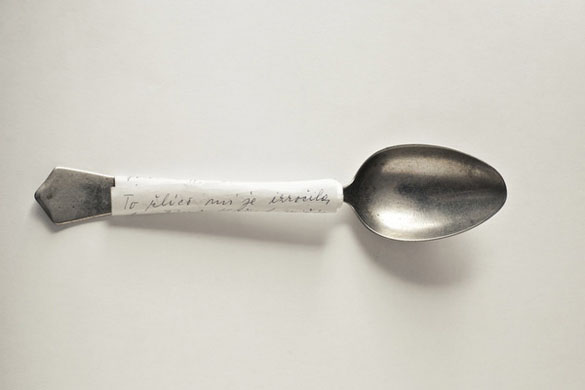
 A silver spoon holds war memories of a nurse Martina Košak (1911-1997). Among them dreadful memories of inhumane conditions at the nursery of the Italian fascist concentration camp on island of Rab. 

Because a nurse, Martina Košak was immediately appointed to an improvised nursery in a building at the time known as the outhouse of Hotel Kontinental. "She was in charge of children. They were laying on the floor. She said it was horrendous. As a woman and as a nurse she should be helping people, being children or adults, but she had nothing to help with," said Mr. Herman Janež, an internee himself, who became a custodian of the spoon.
"There was no water, no paper to put under those children who all had terrible diarrhea.  Warms grew under their bodies. There were no clothes. She told me the experience was so horrible for her that as a woman and as a nurse she couldn't withstand it," Mr. Herman Janež conveyed.
From collected memories, it became known that first babies who were born in the concentration camp Rab were delivered under tents. The nursery didn't improve the conditions. Chances of survival for babies born in the camp were close to none. 

After the war Ms. Košak made a research whether any babies born on Rab have survived. She found four Slovene women, one of them was Marija Mohar who died in 2011. Mr. Janež, who was also researching the issue, found nine men. According to a list of internees on Rab created by Mr. Janež, at least 163 children under the age of fifteen died during the internment. 
Researchers and historians estimate that the annual mortality rate in the Rab camp was higher than the overage mortality rate in the Nazi concentration camp of Buchenwald. 
Concentration camp on Rab was operating from July 1942 to September 1943. 


© The content on this blog may not be reproduced without permission of the authors. Powered by Blogger.